
Baklava calories per piece, and why size decides it
· Viral Tandel
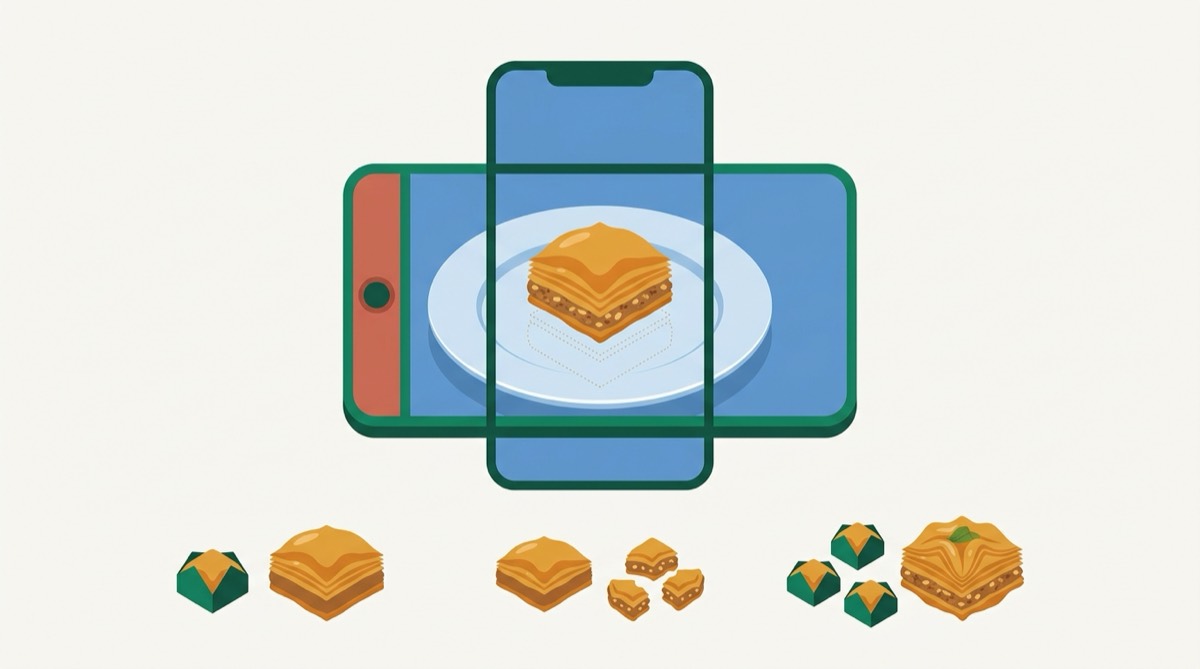
Baklava calories come in at 440 kcal per 100 g, which is the highest figure for any food on this site. The United States Department of Agriculture also publishes two portion weights for it, and the gap between them explains why people's estimates of baklava vary so wildly.
Key takeaways
- 440 kcal per 100 g, the densest figure anywhere on this site.
- USDA weighs a piece at 80 g, about 352 kcal, and a cubic inch at 13 g, about 57 kcal.
- That is a six times range depending on what counts as a piece.
- 29.34 g fat and 37.55 g carbohydrate per 100 g. Butter, nuts and syrup, in that order of impact.
- Estimating in cubic inches is more reliable than guessing grams.
The figures
| Baklava | kcal | Protein | Carbs | Fat |
|---|---|---|---|---|
| Per 100 g | 440 | 6.58 g | 37.55 g | 29.34 g |
| 1 piece, 80 g | 352 | 5.3 g | 30.0 g | 23.5 g |
| 1 cubic inch, 13 g | 57 | 0.9 g | 4.9 g | 3.8 g |
Look at the fat and carbohydrate columns together. Nearly 30 g of fat and nearly 38 g of carbohydrate per 100 g is an unusual combination, and it is the signature of the recipe: filo brushed with butter between every layer, a dense nut filling, and then sugar syrup poured over the whole thing while hot so it soaks all the way through.
Each of those three steps is individually energy dense. Stacked, they produce a figure higher than most chocolate.
Why the piece size matters more than usual
USDA's 80 g piece and 13 g cubic inch are both legitimate portions, and they are six times apart.
A generous diamond from a bakery tray is comfortably the 80 g piece. A small square handed round at the end of a meal might genuinely be one or two cubic inches. Both get called a piece of baklava, and logging one as the other is a 295 calorie error on a single item.
Baklava happens to be easier to estimate than most desserts, because it is cut into regular geometric shapes and served flat. Counting cubic inches, roughly, is a more reliable mental operation than guessing at grams, and it is the rare case where the shape of the food helps you.
It is not a reason to avoid it
Nothing on this site argues that a high figure makes a food wrong. A 57 kcal cube of baklava with coffee is a small thing. A 352 kcal piece is a real part of a day and worth knowing about, in the same way that a slice of pizza is.
The failure mode is not eating baklava. It is eating three pieces that each registered mentally as a small sweet, and finding the day does not add up.
This is the general argument for logging rather than restricting, and it is the same one made in why photo calorie estimates run low: a number you can see is more useful than a rule you will break.
Logging it
Estimate the piece in cubic inches, multiply by 57, and be slightly generous rather than slightly mean, because syrup soaked pastry is denser than it looks.
If it came at the end of a meal that started with a gyro, log both as separate lines. Dessert is the item most often left off a restaurant log entirely.
KalTrack will size the piece against the plate, which is the part worth getting right here. Point it at the tray.
This is general information about published nutrition data, not medical advice. If you are managing diabetes or any condition where sugar matters, talk to a clinician or a registered dietitian.
Questions
How many calories are in baklava?
USDA puts baklava at 440 kcal per 100 g. It weighs a piece at 80 g, which comes to about 352 kcal, and a cubic inch at 13 g, about 57 kcal.
Why is baklava so high?
Because almost everything in it is energy dense. Pastry layered with butter, packed with nuts, then soaked in syrup. USDA lists 29.34 g of fat and 37.55 g of carbohydrate per 100 g.
Is a small piece of baklava reasonable?
A cubic inch is about 57 kcal, which is a modest thing. The difficulty is that baklava is usually cut and served in pieces several times that size.
Does the nut type change the figure?
USDA publishes one baklava entry covering the category, so there is no separate pistachio or walnut figure here. Nuts are similar enough in energy that the difference would be small next to the piece size.
How do I log a piece I did not cut?
Judge it against a cubic inch. Baklava is usually cut into regular diamonds or squares, so estimating how many cubic inches a piece is tends to be easier than guessing grams.
Sources
- USDA FoodData Central, FNDDS, FDC ID 2708044 (baklava): fdc.nal.usda.gov/food-details/2708044/nutrients