AI calorie counter: how photo calorie counting works, and its limits
· Viral Tandel
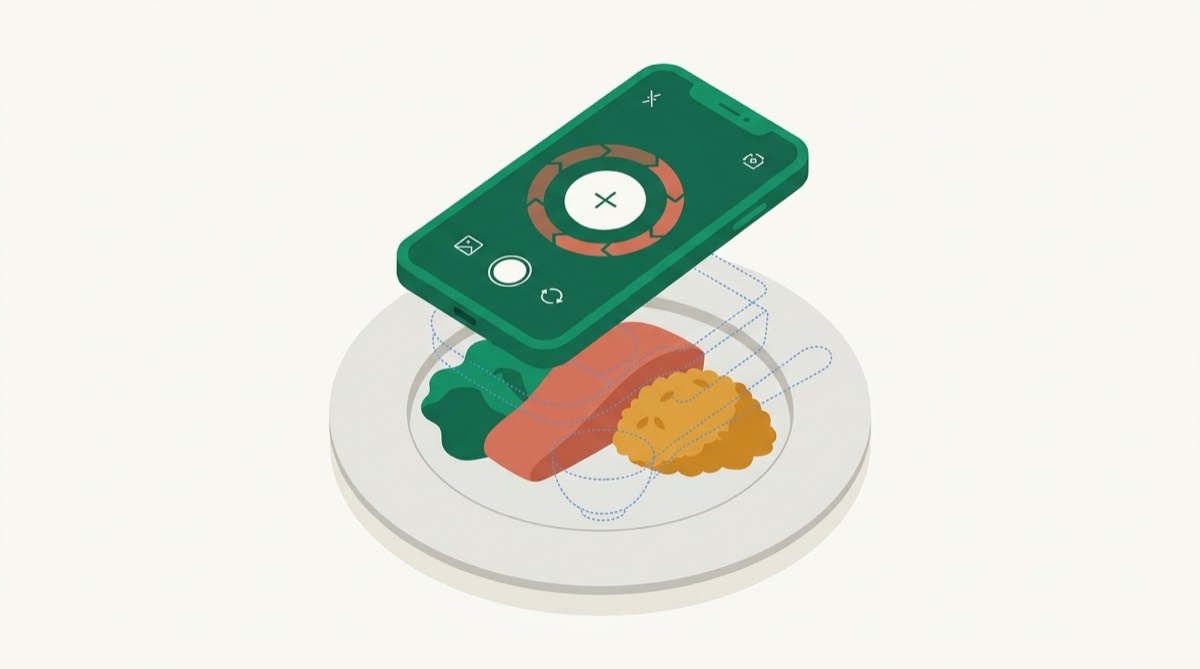
An AI calorie counter takes a photo of a plate and returns a calorie figure. The part worth understanding is what happens in between, because every one of these tools, KalTrack included, does the same three things, and each of the three loses information in the same direction.
Key takeaways
- The pipeline is recognise, estimate the portion, look it up. The number is the sum of the lookups.
- Each step loses information, and the losses all push the estimate down rather than up.
- Independent testing found AI photo calorie tools underestimate by about 33 percent.
- The useful output is not only the number but the recognised items and assumed portions, because those are what you can correct.
- For packaged food, a barcode or label beats any estimate. A good photo calorie counter should make that path easy.
How an AI calorie counter works, step by step
Step one: recognition. A vision model identifies what is on the plate. This is the part that has improved the most in recent years, and for a plain, well-lit plate of recognisable foods it is usually right. It fails on mixed dishes, on cuisines it was not trained on, and on anything where the defining ingredient is hidden, like a sauce or a filling.
Step two: portion estimation. The model guesses how much of each food is there, from the apparent size against the plate, the bowl or whatever reference it can find. This is the weakest step. A photo is two-dimensional. Depth, density and what is underneath are all inferred, and inference under uncertainty tends to be conservative. How to photograph a meal for a calorie app covers what actually helps here.
Step three: database lookup. Each recognised item at its estimated portion is matched to an entry in a nutrition database and the calories are summed. The quality of that database decides a lot, and databases disagree with each other more than people expect, which is set out in where calorie databases get their numbers.
The figure you see is the output of all three. It is an estimate of an estimate of a recognition.
How accurate are AI calorie counters?
Research reported by Healio on 4 August 2026 tested AI photo-based calorie-tracking tools and found they underestimated by roughly 33 percent. The reason the error is so consistent is that almost everything a camera cannot see adds calories:
- Cooking oil and butter, invisible once absorbed.
- Dressing, sauce and cheese under or inside other food.
- The depth of a bowl, where the camera sees only the surface.
- Dense foods that look like lighter ones.
There is no equivalent list of invisible things that remove calories. So the misses accumulate in one direction, and the result is a figure that is a reasonable floor and an unreliable ceiling. Is Cal AI accurate? applies this to a specific product, and the answer is the same as for every other, this site's included.
What a good photo calorie counter does about it
Since the method cannot be made exact, the useful question is what the tool does with its uncertainty.
Shows its work. The recognised items and the assumed portion should be visible, so a bowl of dal read as lentil soup can be seen and changed. A bare number is not correctable.
Makes correction cheap. If fixing a portion takes two taps, people do it. If it means retyping the meal, they do not.
Keeps the exact paths free. A barcode or a nutrition label returns the manufacturer's own figure. That path should be the cheapest one in the app, never gated behind the estimate. Scanning a barcode instead of a photo explains when to reach for it.
Knows more than one cuisine. A counter that maps biryani to "rice, white" or paneer to "cheese" is not estimating, it is guessing with a Western accent.
KalTrack is built on exactly those four choices, and it is still a photo estimator with the limits above. We say so on our accuracy page, with the same study linked.
Five things to check before you trust one
Does it show the recognised items? If the output is only a number, you cannot tell a good estimate from a bad one. Every scan should list what it thinks it saw.
Does it state the portion it assumed? "Chicken breast, about 120 g" is checkable. "Chicken breast" is not. The portion is where most of the error lives, so it is the figure you most need to see.
How many taps to correct it? Count them. If fixing a wrong portion means deleting the entry and starting again, the correction will not happen on a weeknight, and the log quietly fills with uncorrected floors.
Is the barcode path free and obvious? The exact figure for packaged food exists on the packet. A tool that makes you spend a scan credit or dig through menus to use it is pushing you toward the estimate when the measurement is right there.
What does it do with a dish it does not know? Ask it to read a plate of something regional, dal, jollof, pho, and see whether it names the dish or returns the nearest Western thing. The second answer is a sign the database behind it is not built for what you eat.
None of these make the estimate exact. They decide whether you can see the error, and seeing it is what lets you keep a log that means something.
The practical rule
Use the photo for speed and completeness, correct the obvious misses, log the same way every day so the bias stays constant, and use a barcode or label for anything packaged. Done that way, a photo calorie counter is a genuinely good tool. Treated as a scale, it is not.
See what a scan shows you in KalTrack.
This is general information about how photo calorie estimation works, not medical advice. If you are managing a health condition or following a prescribed diet, talk to a clinician or a registered dietitian.
Questions
How does an AI calorie counter work?
In three steps. A vision model recognises the foods in the photo, estimates the portion of each from visual cues, and looks each one up in a nutrition database. The calorie figure you see is the sum of those lookups.
How accurate are AI calorie counters?
Independent testing reported in August 2026 found they underestimated by about 33 percent. The error is consistent in direction because the things a camera cannot see, oil, depth, hidden ingredients, all add calories rather than remove them.
Is a photo calorie counter better than typing food in manually?
It is faster and it is usually more complete, since people forget items when typing. It is not more precise. The best approach is a photo for speed, a barcode or label for anything packaged, and a quick correction when the portion is obviously wrong.
Can an AI calorie counter handle Indian, Chinese or other non-Western food?
Only if it was built to. Most food databases and training sets are Western, so mixed dishes from other cuisines often get mapped to the nearest familiar entry. Check whether the app recognises the dish by its own name.
What should an AI calorie counter show besides the number?
The items it recognised and the portion it assumed. Without those, you cannot tell whether the number is wrong, let alone fix it.